Racing the Annual Maximum: Sequencing Treatment Across Benefit Years
When a patient has more treatment than maximum left, the calendar becomes part of the treatment plan. Accurate remaining-maximum data turns year-end sequencing from guesswork into strategy.

The fourth quarter changes the math
A patient needs two crowns. The plan covers major restorative at 50%, and each crown carries a $1,200 fee. In March, that is a simple estimate: the plan pays $600 per crown, the patient pays the rest.
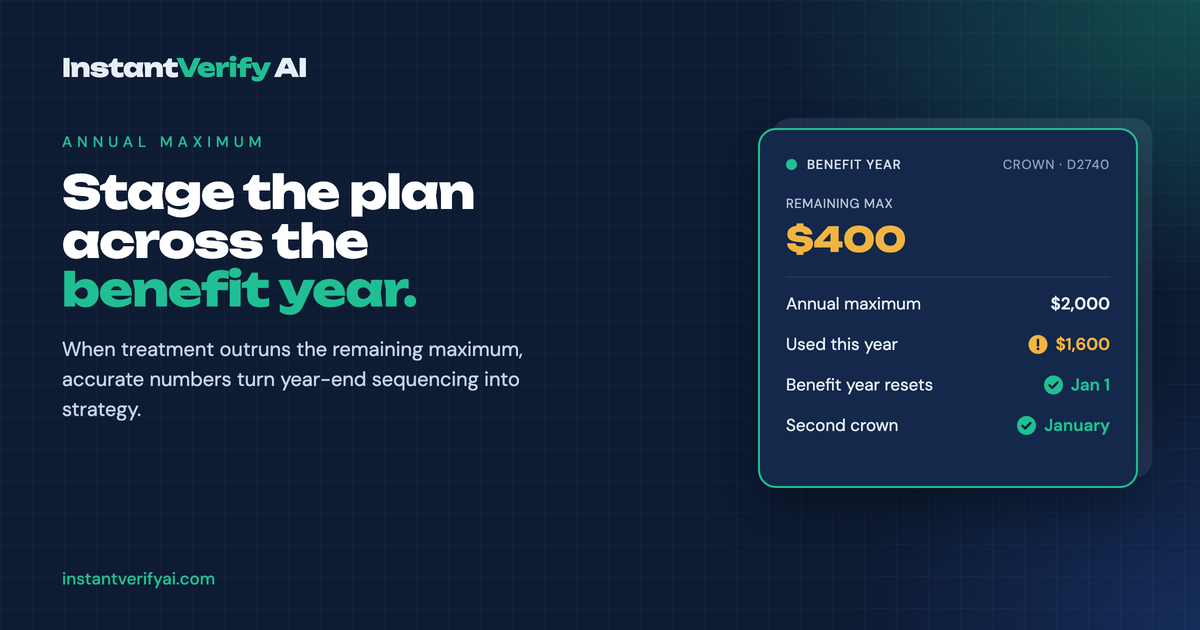
In November, the same case looks different. The patient has already used most of the year's maximum on a root canal and some fillings. Only $400 is left. Do both crowns now, and the plan pays $400 total. The patient covers the other $2,000.
Do one crown now and one after the benefit year resets, and the plan pays $400 this year and up to $600 next year, less any deductible that restarts with the new year. Same treatment, same doctor, a very different number for the patient.
That is what racing the annual maximum looks like. The calendar has become part of the treatment plan.
Sequencing is a clinical and financial decision
Splitting treatment across benefit years is not a trick. It is ordinary planning, and patients appreciate it when the office brings it up first.
But it only works when the clinical picture allows it. A tooth that needs a crown now should not wait three months to save the patient a few hundred dollars if waiting risks a fracture or an extraction. The doctor decides what can safely be staged. The financial side decides how to stage it well.
When staging is appropriate, the questions are practical. Which procedure goes first? What will the plan actually pay for each one this year? What resets, and when?
The benefit year is not always January
This is the assumption that quietly breaks year-end planning. Many plans run on the calendar year. Many do not.
Some plans follow the employer's plan year or fiscal year, which can start in July, October, or any other month. For those patients, December is not a deadline at all, and a plan to "wait until January" can land the second crown in the same benefit year as the first. The reset the whole plan was built around never comes.
The benefit year is a verification field like any other. It needs to be read, not assumed, before anyone builds a sequence around it.
What the remaining maximum really means
The other number that drives the plan is the remaining maximum, and it is less settled than it looks.
- Claims from other offices count. A patient who saw a specialist or a previous dentist this year may have used benefits your practice never saw.
- Pending claims may not show yet. A portal's remaining figure can lag work that has been done but not yet processed.
- Some procedures date differently. Many carriers treat a crown's date of service as the day it is seated, not the day it is prepped, which matters when a case spans December and January.
- Other limits reset too. The deductible starts over with the new benefit year, and frequency limits may follow their own clocks.
An estimate built on last month's remaining maximum is an estimate built on a guess. Near the end of the benefit year, the gap between the two can be most of the case.
Turning guesswork into strategy
Good sequencing starts with good numbers read close to the appointment: the benefit year dates, the remaining maximum as of today, the deductible status, and any frequency or waiting period that affects the procedures in question.
With those in hand, the conversation with the patient is straightforward. Here is what the plan will pay if we do everything now. Here is what it will pay if we stage it. Here is what the doctor recommends clinically. The patient chooses with real numbers in front of them.
This is where procedure-aware verification helps. A check that knows a crown is scheduled reads the maximum, the benefit year, and the crown's history together, and flags anything it could not confirm instead of filling the blank with a guess.
The annual maximum will always be a ceiling. Reading it accurately is what lets the office plan beneath it.
InstantVerify AI helps dental practices automate insurance verification, eliminate missed fields, and deliver confident benefit estimates every day. Learn more →