What the Doctor Sees Before Walking Into the Room

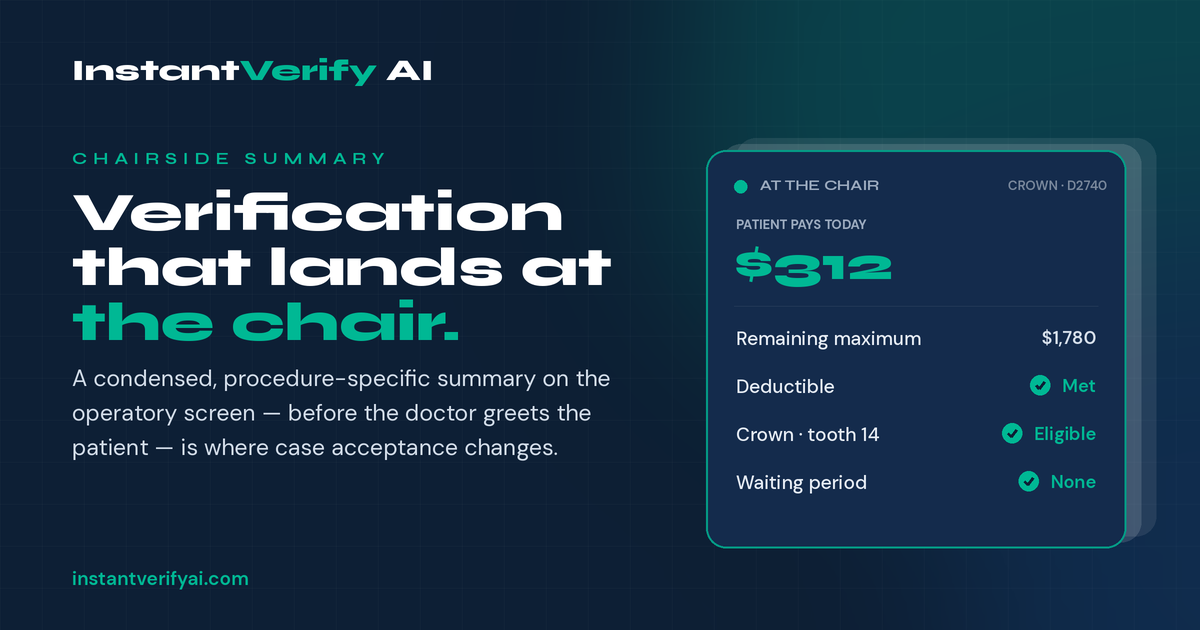
Where verification actually has to land
A verification report is useful in proportion to where it ends up. A complete report that lives only on the front desk computer has limited value at the moment treatment is presented. A complete report that lives in the operatory — where the doctor and patient are making decisions — is something different entirely.
Most verification tools deliver to the front desk. The data is accurate, the formatting is clean, and the team has access to it for billing purposes. But by the time the doctor walks into the room, that data is reduced to whatever the team member remembered to summarize in the hand-off note.
The information was there. The translation was lossy. And the decision the doctor is about to recommend gets made with less data than the practice already paid to collect.
What a chairside summary changes
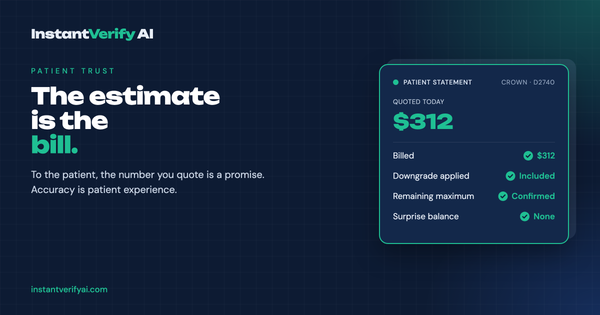
A chairside summary delivers the verified benefit data directly to the operatory screen — visible to the doctor before they greet the patient. The format is condensed and procedure specific. Not the full verification report. The synthesized version: what the patient owes today, what their frequency status is for the procedures being considered, what flags need attention.
That summary changes the dynamic of treatment presentation. The doctor no longer presents in general terms and defers financial questions to the front desk. The doctor presents with specifics — and the patient hears a recommendation grounded in their actual benefit picture, not a generic estimate.
The conversation that follows is shorter, more confident, and significantly more likely to result in same-day acceptance. The patient is not waiting for a number that might come later. The number is on the screen.
The fields that matter at the chair
A chairside summary does not need every field a verification report contains. It needs the fields that affect treatment decisions in real time.
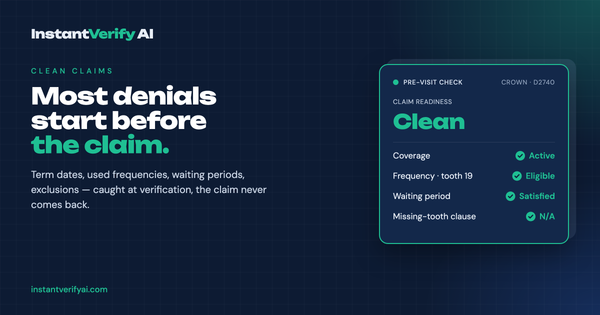
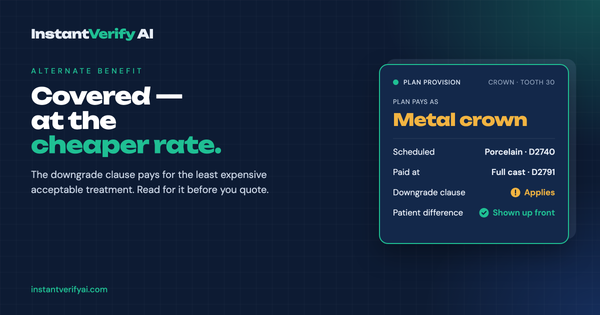
For a patient consiering a crown, tat is te requency status o te toot, te patient's deductible position, the remaining annual maximum, the patient's estimated out-of-pocket cost, and any waiting period or downgrade clause that applies. Five to seven fields, organized to be readable in seconds.
For a patient considering ortho, the fields are different — lifetime maximum, percentage covered, age limits, prior orthodontic history.
The same data the verification system already collected. The summary is the framing that makes it usable in a different context — at the chair, in front of the patient, in the moment the decision is actually being made.
Why this is the destination, not the starting point
A practice that has gotten verification working — accurate, complete, on time — has done the hard part. The remaining work is making sure the verified data lands where it changes the conversation.
The morning huddle is one place that data lands. The patient estimate sheet is another. The operatory screen is the most consequential. It is where the verification finally connects to the moment of treatment acceptance — the moment that determines whether the practice produces what it should.
When verification ends at the front desk, most of its value is left on the table. When verification ends at the chair, the practice operates on a different level. The case acceptance changes. The patient experience changes. The numbers change.
That is what verification is supposed to do. The chairside summary is what completes it.
InstantVerify AI helps dental practices automate insurance verification, eliminate missed fields, and deliver confident benefit estimates every day. Learn more →