Why "100% Accurate" Verification Is the Wrong Promise

The accuracy claim that should make you skeptical
Every verification vendor wants to claim high accuracy. The number sounds reassuring in a sales conversation. It implies a level of reliability that a practice can simply trust without further review.
The problem with the claim is that it cannot be honestly verified at the field level. A vendor that says they are 95% accurate is averaging across thousands of fields, thousands of carriers, and thousands of plan types. Some fields are read with near-perfect reliability. Others are read poorly. The averaged number obscures both.
For a practice presenting a patient estimate, the average accuracy does not matter. What matters is whether the specific number on the screen — for this specific patient, this specific procedure, this specific plan — is the right one.
What confidence scoring does differently
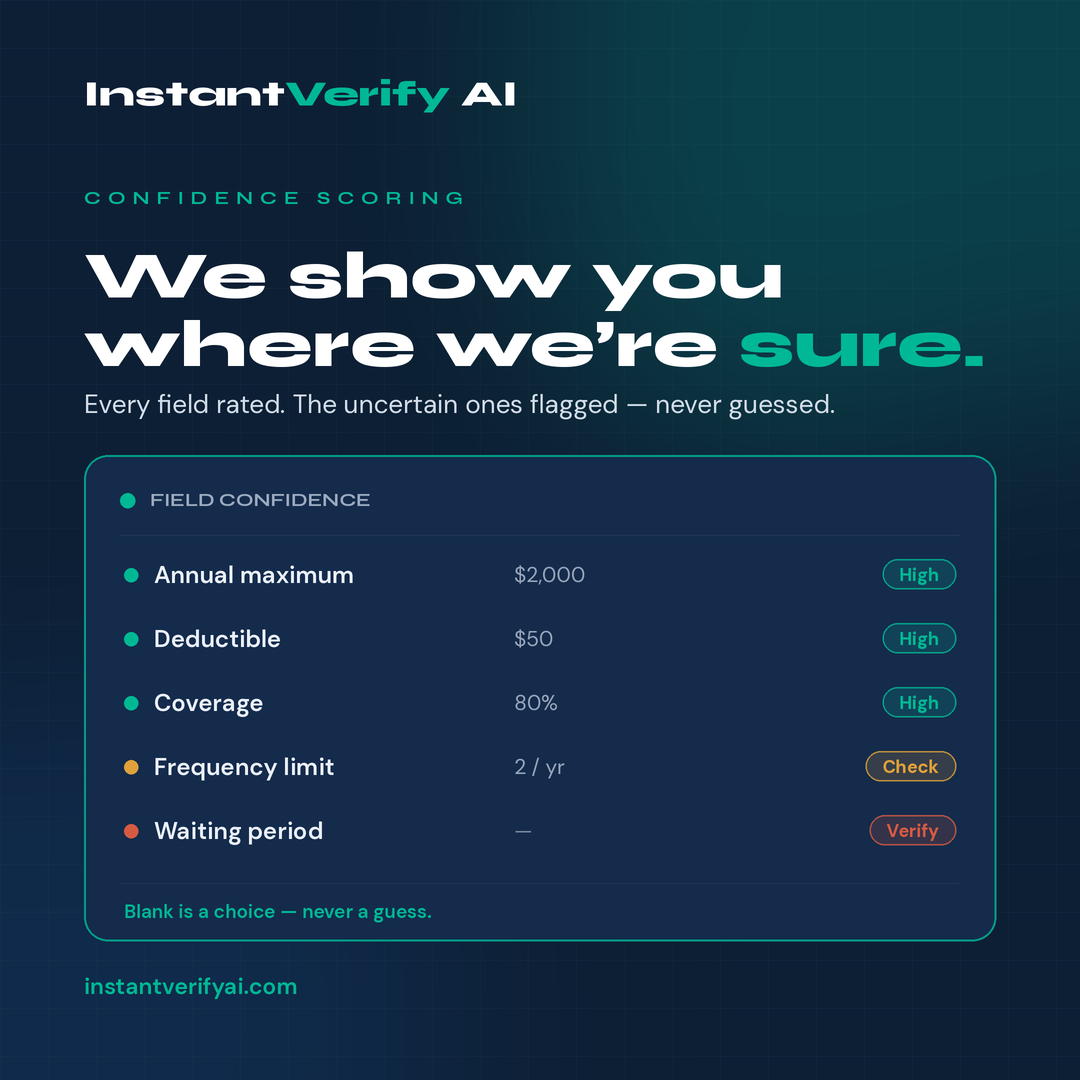
A well-designed verification system rates the reliability of every field it extracts. High confidence fields come from clearly labeled, unambiguously sourced data — typically from explicit portal fields with consistent names. Medium-confidence fields come from interpretive sources — tables, secondary screens, or inferred relationships. Low-confidence fields are flagged for review.
The point of confidence scoring is not to admit imperfection. It is to make imperfection actionable. A team member who knows that the annual maximum was extracted at 97% confidence and the waiting period was extracted at 65% confidence knows exactly where to focus their five-minute review.
That distinction — between data that is verified and data that is presented — is what makes the system usable rather than just impressive in a demo.
The blank field as a feature
The most important design decision in a confidence-based verification system is what to do when the confidence is too low. The wrong answer is to fill the field with a guess. The right answer is to leave it blank and flag it.
A fabricated value looks identical to a verified one. A blank field with a clear note tells the team where their attention is needed. The transparency is more valuable than a number that might be wrong — and the cumulative effect, across thousands of patients, is that the team learns to trust the system because the system tells them when not to.
A verification tool that always returns a number for every field is hiding its uncertainty. A verification tool that returns a clear "unable to verify" with an explanation is showing the practice what it found.
How this changes the review workflow
When every field has a confidence rating, the daily review becomes targeted rather than exhaustive. High-confidence fields require no additional attention. Medium and low confidence fields get a focused second look. Blank fields with flags get resolved before the patient arrives.
The team is not reviewing everything. They are reviewing exactly what needs it. That focus is what makes the workflow sustainable as the practice scales — a system that requires the team to second-guess every field becomes a burden as volume increases.
A system that tells the team where the data is solid and where it is not becomes more valuable as volume increases, because the high-confidence portion compounds and the review work stays proportional to the exceptions.
That asymmetry is what good verification design produces. The accuracy claim is a marketing artifact. The confidence-scored report is the actual product.
InstantVerify AI helps dental practices automate insurance verification, eliminate missed fields, and deliver confident benefit estimates every day. Learn more →