Why a Verification Tool Is Only as Good as the Portals It Knows

The myth of universal coverage
Every verification vendor claims to support every carrier. The marketing slides show the logos. The sales calls confirm the integrations. The reality, when the system meets a portal, is more nuanced.
Each carrier portal is a different system. Different login flow, different layout, different field names, different navigation paths to the same benefit information. A verification tool that "supports" a carrier might pull six fields well and miss the other ten. The integration exists. The depth does not.
For a practice evaluating a tool, the question isn't "does it support my carriers?" The question is "how deeply does it support the specific portals my patients actually use?"
What deep coverage actually means
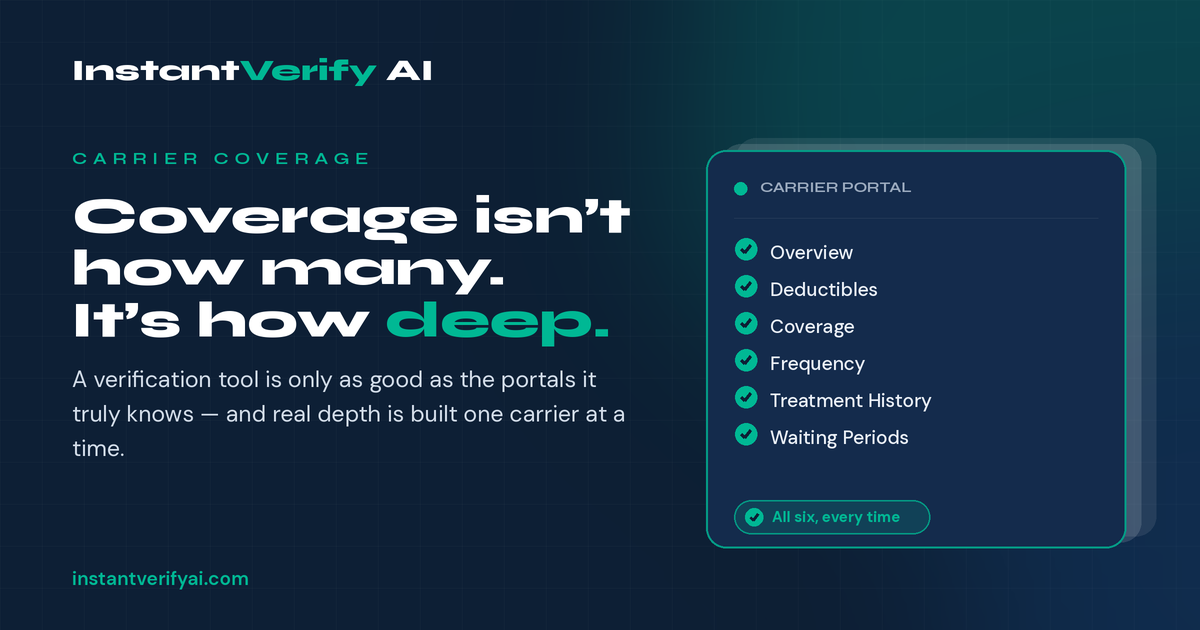
Deep coverage of a carrier portal means more than logging in successfully. It means navigating to every relevant section — overview, plan provisions, frequency history, waiting periods, treatment history — and extracting the fields that drive treatment decisions.
Shallow coverage stops at the overview tab. Deep coverage reads everything a human team member would read if they had unlimited patience. The difference shows up in what gets missed. Shallow coverage returns the obvious fields and inherits the same blind spots as a manual checklist. Deep coverage returns the fields that manual verification routinely skips under time pressure.
That distinction isn't visible in a demo. It's visible in a billing report three months after adoption — in which surprises showed up, in which write-offs accumulated, in which patient conversations became uncomfortable.
Why portal libraries are built one carrier at a time
There's no shortcut to deep portal coverage. Each carrier's interface requires its own mapping, its own navigation logic, and its own validation against real benefit data. A verification system that claims to have built this for fifty carriers in three months has not built it deeply.
A system that has spent the time to build deep coverage for each portal — testing every plan type, validating every field, capturing every login quirk — accumulates a library that's hard to replicate. New vendors can ship a shallow integration with any carrier in days. They can't ship deep coverage at the same pace.
That depth is what determines whether the verification works on a Tuesday afternoon, when the patient has an unusual plan and the team doesn't have time to verify manually.
The portal mix that matters for your practice
Every practice has a carrier mix. A practice in the Northeast might be heavily weighted toward Delta Dental, MetLife, and Cigna. A practice in the Southwest might see more Aetna and UnitedHealthcare. A practice serving employer groups might have a long tail of smaller plans.
The right question for a verification vendor isn't how many carriers they support — it's how deeply they support the carriers your patients actually carry. A vendor with deep coverage of three carriers that cover 80% of your patients is more valuable than a vendor with shallow coverage of fifty.
When you evaluate a verification tool, ask for the specific depth on the specific carriers that matter to you. Ask which fields are reliably returned. Ask what happens when a portal layout changes. Those answers separate real coverage from the kind that exists only on the sales slide.
InstantVerify AI helps dental practices automate insurance verification, eliminate missed fields, and deliver confident benefit estimates every day. Learn more →