The Quiet HIPAA Risk in Most "Modern" Dental Software

The question most evaluations skip
When practice owners evaluate a verification tool, the questions are usually about accuracy, speed, and carrier coverage. The question that gets asked least often — and that matters most for the long-term safety of the practice — is: where does the patient data actually go?
The answer separates verification tools into two categories that look similar on the surface and behave very differently under stress.
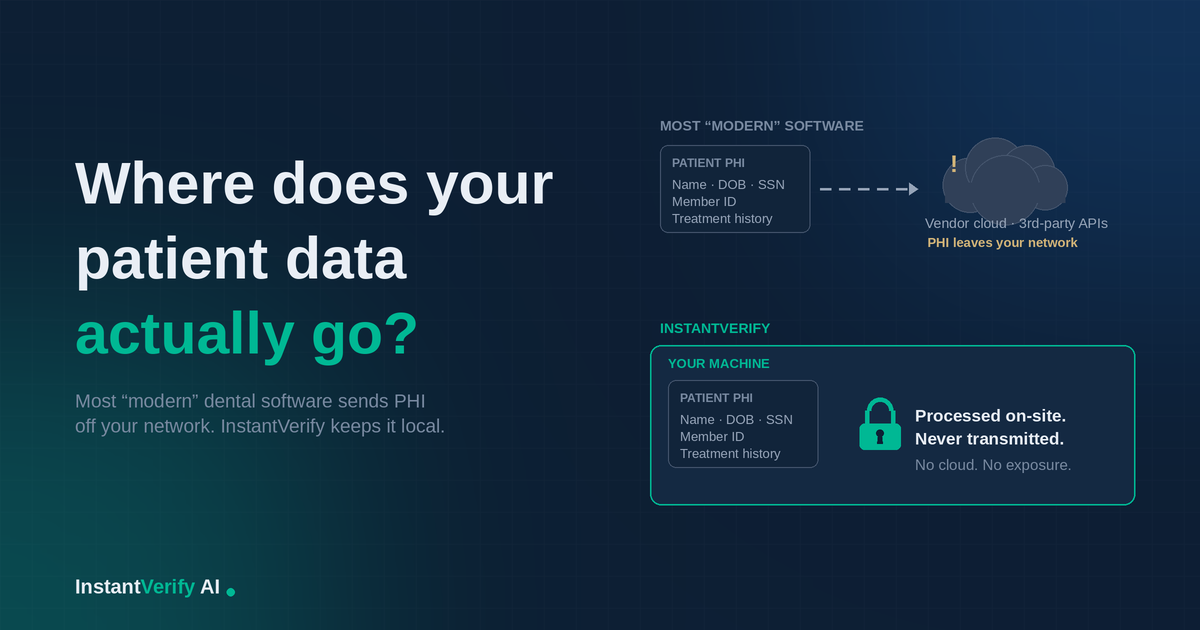
In one category, patient data is sent to an external server, processed in the cloud, stored for some period of time, and returned to the practice. In the other, patient data never leaves the practice's computer. The same verification work happens — the difference is in where the data lives during the process.
That difference matters more than the marketing material suggests.
Why cloud-based verification creates exposure
Every external server that touches protected health information becomes part of the practice's compliance picture. Business associate agreements are required. Breach notification procedures apply. Audit trails need to be maintained.
A cloud-based verification tool isn't inherently unsafe — but it does extend the practice's HIPAA footprint to include every system that handles the data along the way.
When the next major healthcare data breach happens, the question isn't whether the practice was careful. It's whether the practice's verification vendor was — and whether the practice has documentation to prove it.
Most practices don't have visibility into how their vendors handle their data once it leaves the office. The contract says it's handled correctly. The reality is harder to verify.
What local-only processing changes
A verification tool that operates entirely on the practice's own computer — reading from the practice management system locally, accessing carrier portals from the office's own network, and storing results in the local database — keeps patient data inside the practice.
The compliance picture is simpler. The audit trail is contained. The data sovereignty question has a clean answer: nothing leaves the office.
This isn't theoretical. It changes what happens if a vendor is breached, what happens if a vendor is acquired, and what happens if a vendor changes its data retention policies. None of those scenarios affect a practice whose patient data never traveled in the first place.
The trade-offs to be honest about
Local processing has constraints. The system runs on a computer in the practice — that computer needs to be available and updated. The system uses the office's internet connection to access carrier portals — that connection affects performance.
These aren't insurmountable problems. They're operational details that get planned around. The trade-off is between operational simplicity (cloud) and data sovereignty (local). Each has costs. Each is appropriate for different practices.
What isn't appropriate is the assumption that cloud processing is inherently better because it's newer. The newer architecture introduces compliance complexity that older architectures didn't have. For a practice that takes patient data seriously, the question of where that data lives is not a footnote.
What to ask before signing
Where is patient data processed — locally or on external servers? Who has access to that data beyond the practice? How long is data retained, and under what policy? What happens to the data if the vendor relationship ends?
A vendor that can't answer these questions clearly isn't ready to handle protected health information. A vendor that answers them clearly is offering the practice something more valuable than the verification itself — the ability to know exactly what's happening with the data the practice is responsible for.
InstantVerify AI helps dental practices automate insurance verification, eliminate missed fields, and deliver confident benefit estimates every day. Learn more →