Verification Tells You What's Covered. Benefits Breakdown Tells You What It Costs.

The difference that matters at presentation time
When a team member presents a treatment plan to a patient, they aren't answering "is the procedure covered?" They're answering "what will I owe?" Those are different questions, and they require different data.
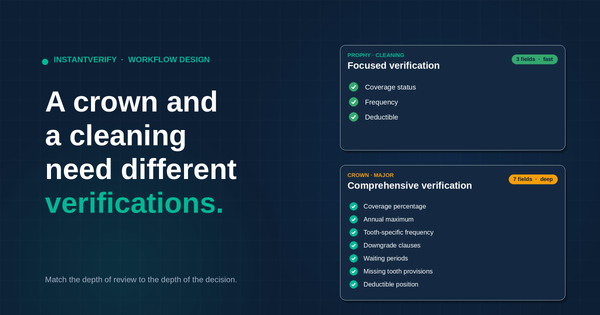
A verification report typically answers the first question. It returns coverage status, plan-level percentages, and a deductible figure. It's correct, it's fast — and it's not enough to produce a reliable patient estimate.
A benefits breakdown answers the second question. It returns the procedure-by-procedure financial picture: what insurance is expected to cover for each CDT code, what the patient owes after the deductible has been applied, and how frequency limits or downgrade clauses affect the final number.
Both are useful. Only one is sufficient for the conversation your team is actually having.
What a benefits breakdown includes that verification does not
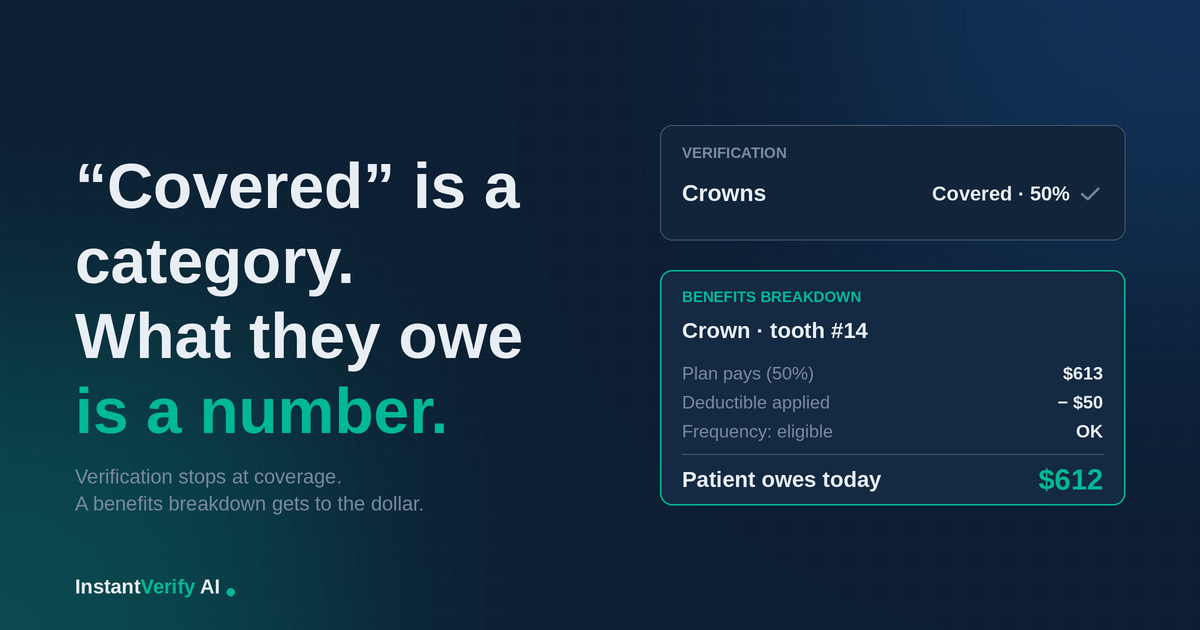
A typical verification report tells you the plan covers crowns at 50%. A benefits breakdown tells you that this specific patient — given their year-to-date usage, applied deductible, and the frequency status of the tooth in question — owes a specific dollar amount for the crown the doctor is recommending.
The difference between those two outputs is the difference between "the plan covers crowns" and "this patient will owe $612 today." One is a category. The other is a number the patient can decide against.
The breakdown also surfaces second-order details that verification typically misses — whether the patient has met any portion of their family deductible, whether their plan year resets mid-procedure, whether a coordination-of-benefits situation affects the primary payer. These aren't exotic edge cases. They're the standard complications that make manual estimates inaccurate.
Why most tools stop at verification
The honest answer is that verification is easier. Pulling coverage percentages and a deductible figure from a portal is a relatively standard task. Computing what those numbers mean for a specific patient — given their history, their plan year, and their treatment plan — is a different kind of work.
Most vendors build to the easier output because it's faster to ship and looks complete in a demo. The harder work — translating verified data into a patient-specific estimate — is left to the practice to do manually. And that handoff is where most estimates go wrong. Verified data is correct. The manual translation step isn't always.
What changes when the breakdown is built in
When the benefits breakdown is part of the verification output rather than a downstream manual step, the patient estimate becomes a direct read of the data rather than a calculation done under time pressure.
The team is no longer translating in their head between what the plan covers and what the patient owes. The number is on the screen. The basis for the number is documented. The patient sees an estimate generated from verified data — and the practice can stand behind it with confidence.
That confidence is what verification was supposed to enable all along. The benefits breakdown is what makes it deliverable.
InstantVerify AI helps dental practices automate insurance verification, eliminate missed fields, and deliver confident benefit estimates every day. Learn more →